Demystifying Digital Twins
This event hosted by Cork City Council focused on clarifying what digital twins are (and are not) and how they differ from 3D models.
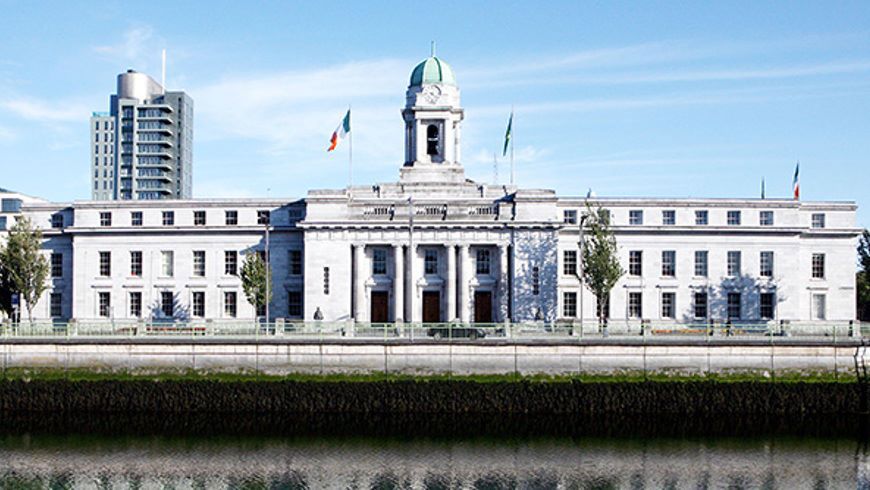
Taking place at Cork City Hall during February 2026, the event brought together national policy leaders, local authorities, infrastructure providers, and ecosystem partners to explore how digital twins can be understood and applied in practice within an Irish local government context.
Rather than showcasing technology for its own sake, the day was designed to bring participants on a journey - from national digital strategy direction, through local delivery realities, to practical, hands-on examples. Attendees will gain a clearer understanding of how digital twins support areas such as energy, transport, planning, and climate action, and how European projects like TIPS4PED are used as sandboxes to test approaches and inform long-term roadmaps.
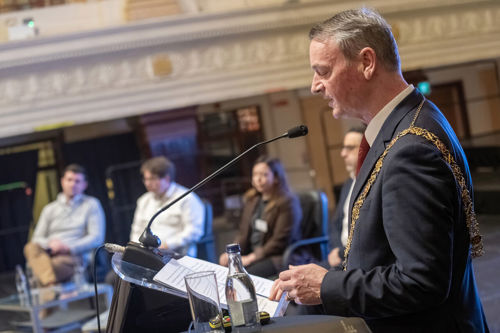
Welcome
Welcome from the Lord Mayor of Cork, Cllr. Fergal Dennehy.
David Joyce, Director of Emergency Management & Climate Action set out the strategic context for the day, and outlined Corks Mission City focus under the EU Climate Neutral & Smart Cities 100 Mission.
From National to Local Practice
Representatives from the Local Government Management Agency, Cork City Council, Tyndall and Republic of Work joined Dr Bilauca to discuss how digital strategy moves from policy intent to practical delivery. The discussion addresses how cities prioritise digital initiatives The role of partnerships and ecosystems What “good” looks like in terms of governance, alignment, and organisational readiness.
Kicking the Tires: Digital Twins in Cork Today
This session was a practical exploration of digital twins and 3D models currently in use in Cork Participants will see real examples including :
- 1. TIPS4PED- IES Digital Twin: Positive Energy District and Energy demand–supply modelling in Cork Docklands City-scale 3D modelling for planning and regeneration Data architecture, repositories, and governance considerations, High-resolution modelling and visualisation, the aim was to allow participants to see how things work, ask questions, and understand limitations as well as opportunities.
- 2. IERC(Tyndall Institute): Data repositories & sovereignty-aligned architecture; decoupled storage with secure APIs feeding the digital twin.
- 3. RealSim’s Cork 3D Model: Current visual environment and the context of redevelopment.
- 4. Prof. Ger Dooley, CoDirector School of Robotics,UL: Corks City Hall Campus, with real time "dolls house" creation on site.
Electrification & Transport
This session grounded the digital twin discussion in real infrastructure realities. Irish Rail and ESB Networks will outline: Planned upgrades and future investment trajectories Capacity constraints and system dependencies Why understanding supply, demand, and timing is critical for planning and delivery This session reinforced why digital twins must be linked to real operational systems, not treated as abstract tools.
Focus on Data Governance, Strategy, and Collaboration
Representatives from University College Cork, Cork City Data Management, CIX, and SFI joined Corks European Project TIPS4PED Manager to discuss the enablers of delivery. Looking forward and identifying what is needed to move from experimentation to sustainable practice. Topics included Data governance and responsibility Strategy implementation Collaboration across local authorities, smart regions, and sectors How learning from European projects can inform long-term roadmaps.