


New Campaign to Encourage More Dog Owners to Clean Up After Their Pets
22/04/2026
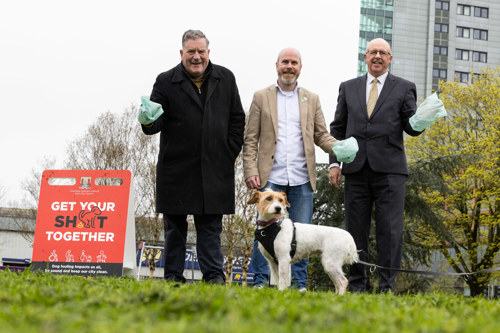
Our new dog fouling awareness campaign has got people talking – and hopefully it will encourage more people to clean up their dog’s waste.
The aim of the campaign, launched this week and featuring the slogan “Get Your Sh*t Together”, is not to shock – it is to grab peoples’ attention to stimulate more debate about responsible dog ownership, and to trigger the required behaviour change to ensure Cork is a clean and welcoming place for all.
Securing a prosecution against dog owners for the offence of dog fouling is very difficult.
Public support and behavioural change are required.
We hope this campaign will encourage that behavioural change.
New dog-walking routes will be developed as part of the campaign to highlight where bins are available for the disposal of dog waste.
Free dog poo bags will also be available free from City Hall Monday to Friday – 10am -4pm while stocks last.
The campaign will be delivered across a range of platforms, including print and digital advertising, bus shelters, and new signage in city suburbs and parks.
It will highlight the risks of not cleaning up after dogs and how this behaviour disproportionately affects vulnerable groups, including young children, older people, visually impaired people, and wheelchair users.
Dog fouling is a serious public nuisance and a health risk.
Dogs are known to be carriers of campylobacter and other bacteria which can prove a health hazard to humans, but the main danger to health in dog faeces is the presence of the eggs of Toxocara Canis, or dog roundworm.
Once in the human body the larvae of these eggs can cause extreme fever and illness and severe damage to organs.
Contact with infected dog faeces can cause loss of sight, with children especially at risk.
Section 22 of the Litter Pollution Acts 1997 to 2009 requires that a person in charge of a dog shall immediately remove dog faeces from a public place or face an on-the-spot litter fine of €150. The maximum court fine is €3,000.