

Making an Irish Free State City – The Winthrop Arcade Story
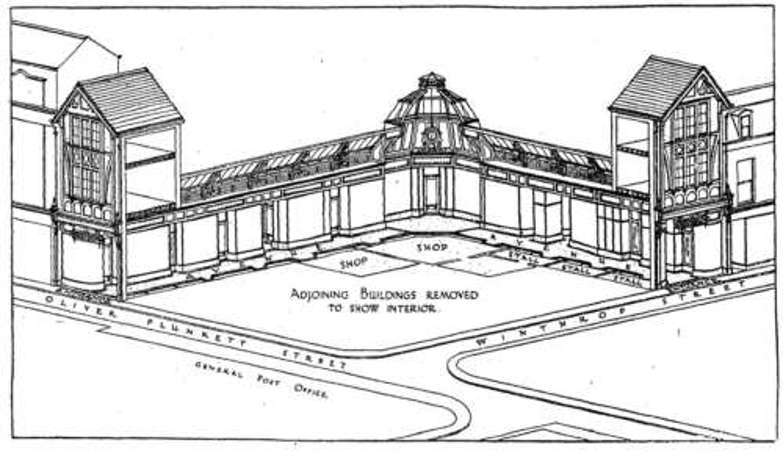
Sketch of Winthrop Arcade by architects Messrs Levie and Chillingworth, March 1926 (source: Cork City Library).
The beautiful Winthrop Arcade was opened on 11 March 1926. It connects Winthrop Street and Oliver Plunkett Street by a glass covered way and consists of twelve shops. It was designed by architects Messrs Levie and Chillingworth, and was constructed by John Delany and Son, builders. The little altered and unique early twentieth-century shopping arcade retains its distinctive timbered façade and arcaded entrance with shop units having terrazzo dado walls and curved plate glass façades. Internally, original features such as bronze frame display windows, glazed timber doors and an ornate clock also survive.
Building on the site commenced in December 1924. Thirteen months later in late February 1926, building and fitting out of the Winthrop Arcade was complete. At that point members of the Cork Industrial Development Authority (IDA) visited the new arcade. The minutes of their visit, which were published in the Cork Examiner on 2 March 1926, detail that the owner or promoter of the arcade Mr Patrick Crowley was congratulated on the day for his “commendable enterprise”.
The newspaper write-up on the visit further reveals that the site of the arcade was formerly a cul-de-sac. Although compensation was paid to Patrick Crowley for some destruction on the site during the Burning of Cork in December 1920, such compensation only represented a small proportion of the capital invested in the new arcade. The members of the Cork IDA complimented Patrick Crowley on his private investment in the building work at a time when speculation in buildings was at a large discount in the city.
The Cork IDA further claimed that the arcade of shops was the first of its kind in the Irish Free State. They noted on the beauty of the plans and workmanship; “The decorative art displayed in the construction is of a high character and reflects credit on the craftsmen and artisans of Cork”.
An article in the Cork Examiner on 8 March 1926 highlights that the materials used in the construction of the shops included marble, mosaic, mahogany, oxidised copper and decolite. The architecture of the structure conformed to the Tudor style. On account of the “centralised system of planning adopted, the subdivided overhead charges and general expenses were as far as each particular shop in the arcade was concerned”, reduced to a minimum. The newspaper article commented on the business types; “The types of business, which will be carried on are specialised and exclusive, the different proprietors will be enabled to sell their goods at very moderate prices”.
The first twelve shops that opened in March 1926 were diverse in their goods – baby linen specialists (Anthonys), select tailors (Fitzgeralds), grocers, tea and fruit merchants (Bannon Stores), fruiterer (Miss Margaret Murphy), vacant suitable for fancies, jewellery, etc, tobacconist (Morriss), lingerie specialities (Miss M Griffin), Le Floriste (Collins), millinery specialist (Marie), needle, craft and novelties (Emer), chemist and druggist (James T O’Sullivan), and knit-wear goods made in Cork (Mrs Agnes Quinn).
The above article is part of a full-length piece by Dr Kieran McCarthy, www.corkheritage.ie
The article can be viewed at the following link:
https://kieranmccarthy.ie/?p=22280


