
Cork City's Emissions Hold Steady as Population Grows, but Faster Action Needed to Reach Climate Goals
22/10/2026
New carbon emissions inventory shows signs of progress but highlights the need for city-wide action to achieve climate neutrality.
Cork City Council has published an updated Baseline Emissions Inventory for 2023, providing a comprehensive picture of greenhouse gas emissions across the city and resetting a benchmark against which future progress can be measured.
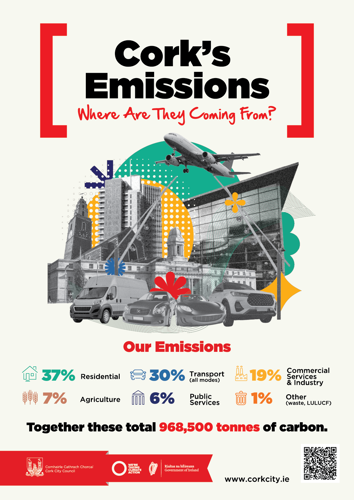
The inventory estimates that Cork City's total emissions in 2023 were 968.5 thousand tonnes of CO₂ equivalent, marginally down from 2018 levels. Significantly, this stability has been achieved during a period of population growth, increased housing delivery, and expanding economic activity across the city.
As in 2018, our homes top the list for emissions sources, at 37%, followed by transport (30%), and commercial and industrial activities (19%). But per capita emissions have fallen by approximately 8% since 2018, reflecting the increasing share of renewable energy in Ireland's electricity supply.
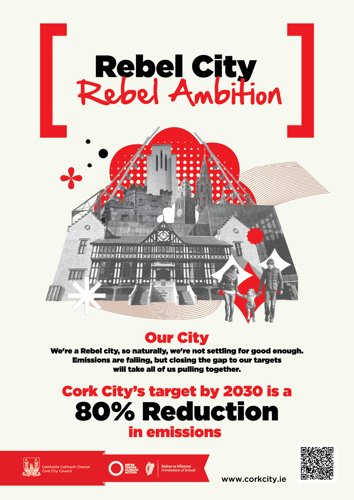
While the latest findings show encouraging signs of progress, they also underline the scale of the transformation required over the coming years. As one of Europe's Mission Cities, Cork has committed to achieving an ambitious 80% reduction in emissions by 2030.
David Joyce, Director of Service, Emergency Management and Climate Action, said: "The findings show that while emissions in the city have remained broadly stable, despite population and economic growth, there is a substantial challenge ahead, particularly in the residential and transport sectors. Climate action is everyone's business. Success will depend on strong partnerships between local government, communities, businesses, national agencies and individual citizens."
The report also examines future emissions scenarios to 2030. These projections indicate that, while current and planned measures will reduce emissions, Cork City as a whole is not on course to achieve its 2030 climate targets. This means new and more ambitious measures are needed, particularly in housing, transport, and energy. The report recommends further actions capable of accelerating emissions reductions in those areas.
Tackling housing and transport emissions is a mammoth task, but it is not insurmountable. The city’s housing stock is, on average, less energy efficient than the national average, so the immediate challenge is to enhance the energy efficiency of the city's homes, enabling a scalable transition toward electrified heating. More compact growth in the city core, a significant shift towards active travel and increased use of public transport would reduce transport emissions, with further reductions achievable through the uptake of electric vehicles.
The findings offer a realistic but hopeful message. Maintaining emissions at 2018 levels while the city continues to grow demonstrates that progress is possible. However, to achieve the steep emissions reductions required by 2030 every sector of society must take faster and broader action. A successful climate transition for the city will depend not only on policy and investment, but on the participation of residents, communities, businesses, and institutions working together to build a cleaner, healthier and more resilient city.
The Baseline Emissions Inventory is available at the below link where you can also find information on how to save money and reduce your energy use.
https://www.corkcity.ie/en/climate-action/cork-city-baseline-emissions-inventory-2023/
In 2023, as part of the development of the Cork City Climate Action Plan, Cork City Council published the city’s first based on 2018 data https://publications.corkcity.ie/view/803534487/). The updated inventory was prepared by KPMG Future Services, using an internationally recognised methodology developed by the International Council for Local Environmental Initiatives (ICLEI). It draws on the most up-to-date national and local data available.
As one of the EU’s Mission Cities (https://www.corkcity.ie/en/climate-action/eu-climate-neutral-and-smart-cities-mission/), Cork City is committed to achieving climate neutrality by 2030, with a target of at least 80% greenhouse gas emissions reduction over 2018 levels.
Summary of Key Findings
- Total city emissions in 2023 were 968.5 thousand tonnes of CO2 equivalent (ktCO₂e).
- Overall emissions remained almost unchanged compared with 2018 despite population growth, additional housing and increased economic activity.
- Residential buildings (356 kt CO2e; 37%), transport (288 kt CO2e; 30%), and commercial and industrial activities (183 kt CO2e; 19%) account for 86% of the city’s emissions.
- Per capita emissions fell by approximately 8%, to 4.3 tonnes CO₂e per person.
- Cork City Council's own operational emissions have fallen by 18% since 2018, demonstrating strong progress towards its statutory target of a 51% reduction by 2030.