Learning about Archaeology: Lecture Series and Resources
Autumn Archaeology Lecture Series
The City Archaeologist is actively involved in promoting knowledge and appreciation of the history and archaeology of the city. A very successful autumn lecture series featuring the City Archaeologist and guest speakers has taken place in the City Library since 2015, continuing online through the pandemic and returning to the City Library in recent years. Previous series have included Digging for Cork - Urban Excavations which featured discoveries from recent excavations at Barrack Street and North Main Street, and Knowledge Sharing: Cork’s Urban Heritage Urban Boundaries.
The series, Know Your Monuments, focused on monument types such as prehistoric Fulacht Fiadh and Ice Houses. The audio presentations are available below; doubleclick on the images to view the full presentations.
Know Your Monuments: Fulacht Fiadh, 23/11/2021
Know Your Monuments: Icehouses, City Archaeologist Ciara Brett, 23/11/2021
Know Your Monuments: Standing Stones, Niamh Daly, 26/10/2021
Amanda Clarke has studied over 300 holy wells in Cork and in this presentation gives an overview of their type and function. www.holywellscorkandkerry.com
Cork Public Museum
Cork Public Museum is the oldest local authority museum in Ireland and celebrated its 75th anniversary in 2020.
The museum is housed in two buildings: a mid-nineteenth century Georgian style house, and a modern extension that was opened in 2005. The two storey Georgian house commands a central position in Fitzgerald Park, Cork. Originally built in 1845 by the Beamish family, the building, then known as The Shrubbery, was their family home for decades. The property and surrounding land was eventually purchased by Cork Corporation for the purpose of housing the Cork International Exhibition of 1902 and 1903. The site of the exhibition was opened as Public Park in 1906.
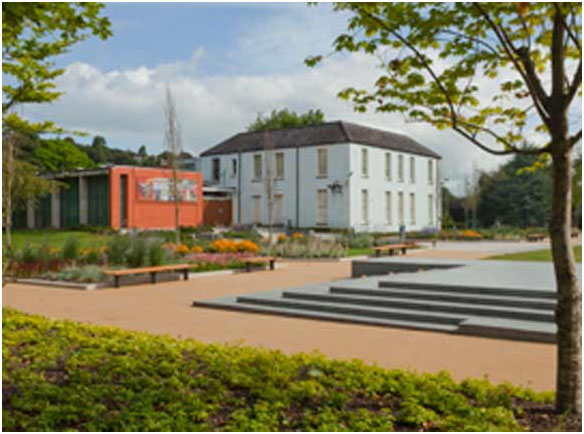
Since opening in 1945, Cork Public Museum has actively collected, exhibited and cared for a wide range of objects related to Cork’s diverse historical heritage. The present collection is made up of about 40,000 objects covering a variety of subjects from archaeology and natural sciences, to the political, cultural and social history of Cork city and county. In addition to the accessioned material, Cork Public Museum currently has loans from institutions such as UCC, the National Museum of Ireland and many other private individuals. Approximately 9-10% of the collection is currently on long-term loan from other institutions or individuals.
Visit Cork Public Museum for more details.
Nano Nagle
Honora (Nano) Nagle was born in 1717 into a wealthy, well-connected Catholic family in Cork that had managed to retain its lands under the Treaty of Limerick.
Growing up while the penal laws – designed to subdue and diminish Irish Catholic power – were in full force, she was sent to a convent in Europe aged 10 and on completing her education moved to Paris, where she lived among the high society. After spending two years in a French convent, she returned home, her Jesuit confessor having told her it was her duty to instruct Irish children.
Nano Nagle established a school in Cork city, and subsequently six others, in which poor boys and girls from the streets were taught reading and catechism, with the boys also learning to write and the girls learning needlework. It was a steady enough start, ultimately transformed by a large inheritance, but Nagle wanted to establish a convent in Cork to undertake the project. After finding the Ursuline order was not fit for her purpose, Nagle wore down the opposition of the Bishop of Cork and established her own order in 1785, which eventually became known as the Presentation Sisters.
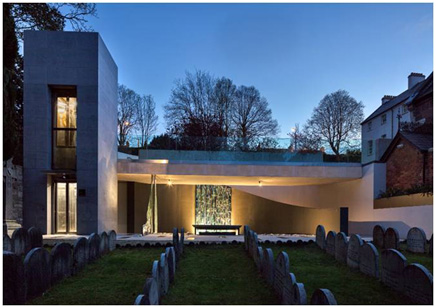
Nano Nagle’s Tomb at Nano Nagle Place (Photo Credit: Nano Nagle Place)
Take a visit to the former South Presentation Convent at Nano Nagle Place on Douglas Street and experience what life would have been like in the 18th century Cork.
Cork City Libraries
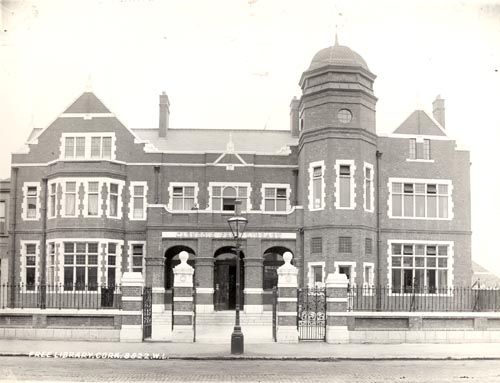
(Photo: Carnegie Library on Anglesea Street from the Lawrence Collection).
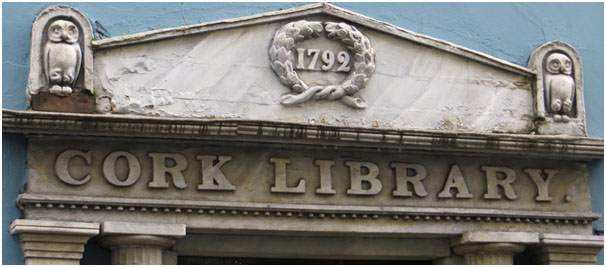
(Photo courtesy of https://readingthesigns.weebly.com/)
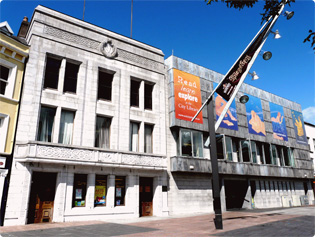
Photo courtesy of Cork City Library, Grand Parade
Cork was the first Irish city to adopt the Public Libraries (Ireland) act of 1855, which allowed municipal councils to establish a library and charge an annual rate of a maximum of one penny on city businesses to support it. However difficult financial circumstances meant that a library service was not opened until December 1892, in what is now the Crawford Municipal Art Gallery.
An application was made in October 1901 to Andrew Carnegie by the then Lord Mayor, Edward Fitzgerald, for a donation ‘with a view to establishing a free public library for the great and important City of Cork.’
£10,000 was gifted to the people of Cork by Mr. Carnegie in August 1902 for the purpose of building a new free library in the city. The official opening took place on September 12th, 1905, at 2.30 pm and was conducted by the then Lord Mayor, Alderman Joseph Barrett.
This building lasted for only 15 years, until 1920, when it and its contents were destroyed by fire, along with City Hall and much of the city centre by British Crown Forces. The burning of the Carnegie Library left the city without a public library service until 1924, when premises were provided on a temporary basis on Tuckey Street. That service transferred in 1930 to its current location at 57-58 Grand Parade.
For its first eighty years, Cork City Library operated from just one location Grand Parade. The 1970s saw the beginning of more library development.
- The original premises were expanded in the mid-1970s.
- The first branch library was opened at St Mary’s Rd in 1972. This library relocated to Blackpool Shopping Centre in 2010.
- 1976 saw the first library in Douglas, this service was relocated in 2010.The library was destroyed by a fire in 2019, however it re-opened in December 2020.
- The original library in Hollyhill opened in 1980 and relocated to its present site in 2015.
- Tory Top Road library in Ballyphehane opened in 1974, with the building being replaced in 2005.
- The Frank O’Connor Library in Mayfield opened in 1984.
- A new library in Bishopstown opened in 2006
- 2007 saw the advent of the award-winning Housebound service which operates a mobile service to those unable to attend the library in person.
Check out the website for further details: Cork City Libraries
Did you know?
An online service of Cork City Libraries includes “Cork Past and Present” where you can learn and view the old maps, photos, prints, genealogies, and cultural life of Cork in days gone by. The library also provides a range of information services including books, learning and research support, children's services, music, 3D printing and internet access.
University College Cork
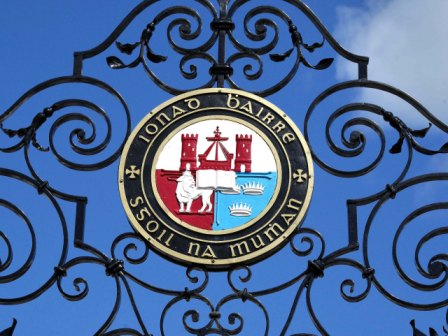
Photo Credit: Tomas Tyner, UCC
University Walk- A self-guided walking tour of the University area of Cork City.
To begin with we look to the ceremonial gates of University College Cork on Western Road, built in 1929 and note the college’s crest placed high up on the black gates. The crest reads “Ionad Bairre Scoil na Muman” which translates as “Where Finbarr thought let Munster learn”. The crest was designed in 1889, comprising of the arms of the City of Cork. Depicted on the crest (see image below) are two castles believed to be the Queen’s and King’s Castle and a large ship entering between the two castles. The royal lion and the three crowns symbolise the ancient sub-divisions of Munster (the Ormond, the Desmond and Thomond) and in the centre of the crest there is the open book of learning.
St Finbarr, Cork’s patron saint, has become synonymous in Cork with many of its sporting, and religious institutions being named after him. Allegedly, St Finbarr founded a monastery and school here in Cork during the early seventh century somewhere between UCC and St Fin Barre’s Cathedral although the precise location has yet to be discovered.
In a recent interview UCC Emeritus Professor Pádraig Ó Riain, (Department of Early and Medieval Irish) explains that “The cult of St Finbarr in Cork had more to do with church politics than historical fact,” and that “Finbarr’s school was located at his church in Movilla near Bangor in the Ards Peninsula in Co Down. What reached Cork was devotion to the saint rather than the man himself”. Professor Ó Riain further explains that "The legend attached to the saint included his reputation as a teacher hence when the third Lateran Council of the Church decreed in 1179 that each cathedral should provide an income to support a school master it was decided to give the new school in Cork a good start by attributing the original founding to St Finbarr, thus lending lustre to the fledgling school”(quotes taken from the Irish Examiner Newspaper Interview, 25th September 2019).
UCC boasts a fine statue of St. Finbarr designed by Cork Sculptor Seamus Murphy who casts his shadow over the Aula Maxima in UCC. The saints feast day is celebrated on September 25th. 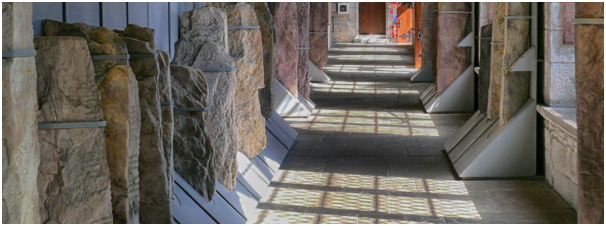
Photo Courtesy of Tomas Tyner, UCC
Outside the Aula Maxima in UCC, in the north cloister of the Quadrangle building is the stone corridor which is an impressive display of Ogham Stones collected and donated to the university by 19th century antiquarians. Many of the Ogham stones in the stone corridor originate from sites in Co. Cork and are believed to date from the 4th to the 8th centuries AD. This time represents the emergence of Christianity in Ireland. These tall perpendicular stones have inscriptions in the style of horizontal or diagonal lines or notches representing an early form of the Irish language. Believed to be associated with burials the names depicted on the Ogham Stones often represent genealogical affiliations with particular areas. If you would like to learn more about Ogham Stone, Dr Nora White, a previous speaker on the Autumn Archaeology series has an informative podcast on the Amplify Archaeology Podcast series coordinated by Abarta Heritage. These podcasts feature a series of interviews on various themes with an array of archaeologists and specialist from Ireland.
Through the coolness of the stone corridor reading ogham into our trite conversation into the quad and sunshine and bodies making ogham lines along the path until our conversation turns to stone. Making a meal of dining out with you flashing your plastic in my face and stammering in my ear – how could you accuse me of playing with your heart as you stuffed your face. ‘Arts as a faculty’ you said ‘is way down the line’ so I took to reading stones in the stillness and compared your mind to a corridor. From gothic windows I saw magic in the mist hanging over the quad and felt the druidic splendour of those stones.
Hopkin, A. On the banks Cork City Poems and Songs 2016 pg. 305)
DID YOU KNOW? In UCC in 1934 the statue of Queen Victoria was replaced by the statue of Cork’s patron saint, St. Finbarr. Bizarrely her statue was buried in the president’s garden in UCC and in 1995 to celebrate the 150th anniversary of the college’s foundation she was placed back on permanent display and preserved as a work of art and as a reminder of historical events.
DID YOU KNOW? UCC was constructed during the height of the Irish Famine (1845-1849) and opened on November 7th, 1849. Originally named Queen’s College Cork after Queen Victoria who was present at the opening event. The perpendicular Gothic style was designed by architects Benjamin Woodward and Sir Thomas Dean.
Rubicon Heritage
If you would like to find out more about the role of an archaeologist, Rubicon Heritage based in Midleton, Co. Cork have a very informative webinar series on YouTube “Introduction to Archaeology” which covers topics such as the legal framework, the planning process, methods and practices and archaeology in the construction industry.
Selected Bibliography
Useful webpages for the archaeology and heritage of Cork:
https://www.corkcity.ie/en/council-services/services/arts-culture-heritage/archaeology/
https://digital.corkpastandpresent.com/
St Finbarr:
https://roaringwaterjournal.com/2015/10/11/william-burges-and-saint-fin-barres/
https://roaringwaterjournal.com/2020/05/24/to-puncture-the-mysterious-finbarr-and-the-serpent/
https://roaringwaterjournal.com/2015/03/28/corks-rebel-daughter/
Local publications available at Cork City libraries
Cadogan, T. 2003. Cork in Old Photographs. Gill and Macmillan.
Fitzpatrick, J. E. 2005. A city of Surprises: Hidden Treasures of Cork’s Northside. Cork: Fitzpatrick Press
Herlihy, R. 2010. A Walk Through the South Parish: Where Cork Began. Cork: Lee Press.
Hopkin, A. 2016. On the Banks Cork City in Poems and Songs. Cork: Collins Press
McCarthy, K. 2019. Cork City: History Tour Great Britain: Amberly Publishing.
McGonagle, H. 2015. A Room of Their Own – Cork Carnegie Free Library and its Ladies Reading Room. Cork: Cork City Library.
McManus, D. 2004. The Ogham Stones at University College Cork. Cork:Cork University Press
Mullins, J. and Ronayne, L. 2005. A Grand Parade: Memories of Cork City Libraries: 1855-2005. Cork: Cork City Council.
Murphy, J. A. 1995. ‘The College: A History of Queen’s/University College Cork’ Cork: Cork University Press.
O’Callaghan, A.2010. Cork’s St Patrick’s Street. Cork: Collins Press.
In the presentation here we learn about some of the unusual sites and features in the urban city centre. Remember to look up and around when you are strolling around as very often the most interesting heritage can be the most ordinary item from the past, such as a wheel guard at an entrance to a building or a feature on a window or door frame.
See below some useful links to the visitor attractions in the city. Also included are guides to four city centre walking trails.
https://www.corkcity.ie/en/things-to-do/attractions/
https://www.corkcity.ie/en/things-to-do/parks-outdoors/cork-city-walks/
Select Bibliography:
Bracken, G & A. 2018. Cork Strolls: Exploring Cork’s Architectural Treasures. The Collins Press: Cork
McCarthy, K. 2016. Cork City History Tour. Amberly Publishing: UK.
O’ Callaghan, A. 2019. Read All About It Sculptures & Monuments in Cork City-An Illustrated Exploration. Cork City Libraries: Cork.
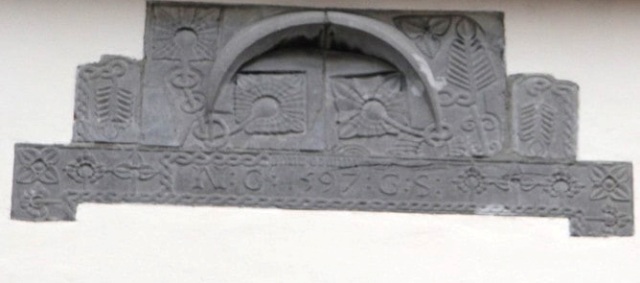
Cork City is one of the oldest cities in Ireland and has a rich archaeological heritage. The continuous occupation of Cork City for over 1400 years spans many changes in religious doctrine, interpretation, ecclesiastical organisation and ritual as well as associated burial practices and traditions. In the presentation here Ciara Brett, City Archaeologist, examines the origins and development of burial grounds in the city and introduces the various types of burial places in the city using some case studies to illustrate the archaeological discoveries uncovered at some sites.
Cork City’s Burial Places (2011) Research by H. Kelleher and F. McCarthy (Editor: C. Brett) This book examines the origins and development of burial grounds in the city. They vary from churchyards, churches containing vaults, private burial grounds of religious houses and the military, stray find spots of skeletal remains large modern cemeteries.
“The Modest Man", Triskel, Christchurch
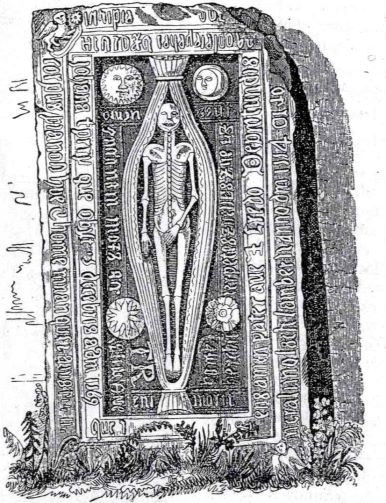
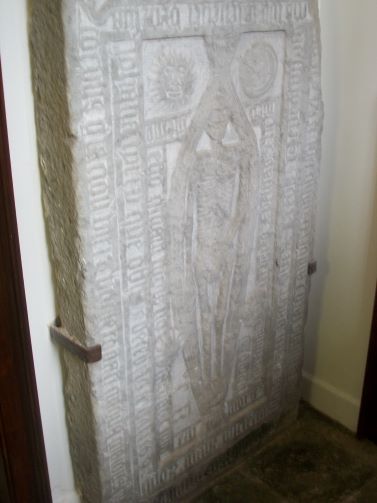
Did you know?
Stones from the ruins of Shandon Castle were used for the building of St. Anne’s Shandon.
Did you know?
The kink in the spire of Trinity Presbyterian Church is said to have been made deliberately by disgruntled workers in a wage dispute. Although a nice (or perhaps not such a nice) story, it is probably simply the result of bad workmanship, a pity on such a beautiful building.
Did you know?
John Hogan, one of Ireland’s most important nineteenth-century sculpture, selected the marble he used for the Dead Christ in St Finbarr’s Church from the same quarry in Carrara, Italy that Michelangelo used.
Did you know?
The organ of St Fin barre’s Cathedral was originally located over the central entrance but is now under the chancel floor, making it the only underground church organ in the world.
Did you know?
Triskel Christchurch’s organ was a gift to the church from Sir Francis Drake. He found it among the treasure seized from a Spanish galleon. Intended as a gift for the King of Spain to the people of Mexico, it was made in Leipzig, Germany.
In this video presentation, Ciara Brett, City Archaeologist, examines the archaeological record and selected artefacts that are associated with the everyday lives of those who lived during the medieval period.
Niamh Daly, Consultant Osteoarchaeologist, gives a short overview of plagues, epidemics and pandemics in Irish history drawing from the historical and archaeological sources.
Niamh gives a detailed examination of some of the skeletal remains uncovered from the excavations at Christchurch conducted by Dan Noonan Archaeological Consultancy in 2009. Case-studies include some common and unusual pathologies recorded associated with dental disease, habitual activities, metabolic disease, and incidences of antemortem trauma.
Dave Swift, from Claiomh Living History, has put together 2 interesting videos on Late Medieval Drinking Vessels and Medieval Archery. These videos were funded by the Heritage Council.